Policy Recommendations
ADI's academic contribution to Indonesian policy on education, research, food and energy, and lecturer certification.
RDPU Academic Input: Revision of Law No. 14 of 2005 on Teachers and Lecturers
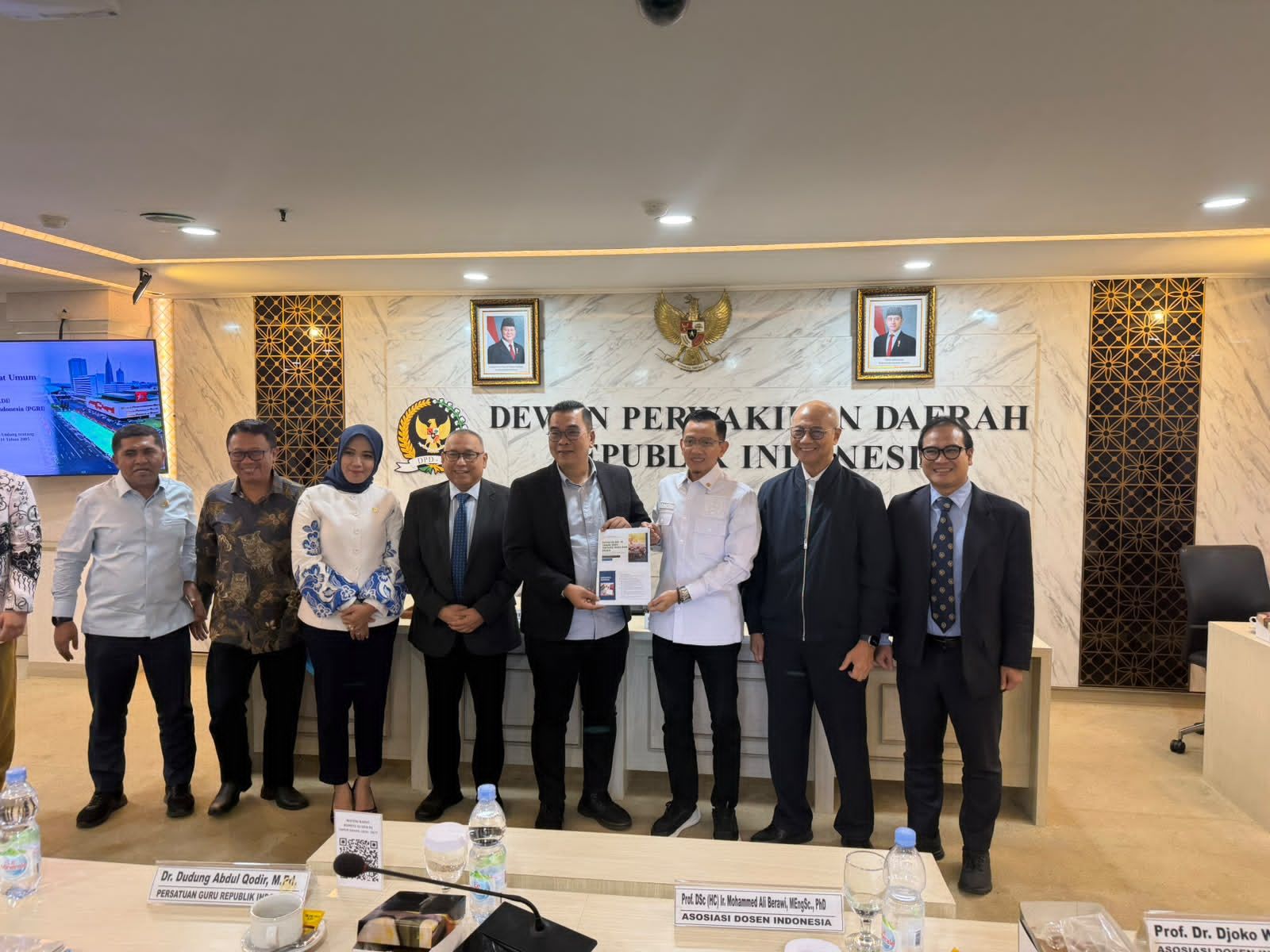
Presented by ADI President Prof. D.Sc. Ir. Mohammed Ali Berawi, M.Eng.Sc., Ph.D. · Jakarta, 15 September 2026
Two decades after the Teachers and Lecturers Law, ADI considers its main weakness not its intent but norms that are vague, unmeasurable and hard to enforce. This academic input proposes moving the welfare promise into the body of the law, with quantitative benchmarks and clear sanctions.
- Every lecturer’s base salary should be no lower than the local minimum wage, and for lecturers at least twice that, regardless of employment status.
- Base salary is calculated separately, may not be topped up with allowances, and is adjusted yearly with the minimum wage.
- A three-layer income structure: fixed income, fixed conditional allowances, and variable income that adds to, never replaces, the first two.
- Tackling inequality: a ban on sub-standard pay with sanctions, state-budget support for verified under-resourced private institutions, phased removal of honorary status, and affirmative measures for 3T regions.
- Harmonising the civil-service and labour regimes, professional and legal protection, and a stronger role for professional organisations in ethics, certification and legal aid.
Policy Recommendations
Asosiasi Dosen Indonesia drafted policy recommendations in 5 areas based on data and analysis by its member lecturers. The summary below quotes the strategic issues and recommendations as written in ADI's official document “ADI untuk Indonesia Maju”.
1 Primary and Secondary Education
Strategic Issues
- Indonesia's Human Development Index (HDI) in 2023 was 74.39.
- Gross enrolment ratio: primary 105.62, junior secondary 92.51, senior secondary 86.34.
- According to Worldtop, Indonesia's education ranks 67th of 209 countries.
- PISA: Indonesia ranks 68th of 81 countries, scoring 379 in mathematics, 398 in science and 317 in reading.
Recommendations
- A National Education Roadmap 2025–2045 toward Golden Indonesia 2045.
- Revise Law No. 20/2003 on the National Education System and Law No. 14/2005, including separate laws for teachers and lecturers.
- Early childhood, primary and secondary education governed by a single ministry.
- Stronger character and religious education, especially in the first 3 years of primary school.
- Fair distribution of qualified teachers and better teacher welfare, especially in remote (3T) regions.
2 Higher Education
Strategic Issues
- No Indonesian university is in the QS WUR Top 100; UI (237), UGM (263), ITB (281), Unair (345), IPB (489).
- In 2022 there were 316,912 lecturers, but only 18.44% held a doctorate (BPS).
- Graduate unemployment rose from 4.8% (2022) to 5.18% (2023).
- No Indonesian university is in the Top 30 of the Global Employability University Ranking and Survey (GEURS).
Recommendations
- Separate laws for teachers and lecturers; faster lecturer certification involving ADI as the professional association.
- Clustering lecturers (teaching, research, practitioner) and universities (teaching, research, entrepreneur university).
- Digital higher education with artificial intelligence, Big Data and IoT; curricula aligned with industry needs.
- Higher education, research and technology under one ministry.
- Better lecturer welfare and capacity, orderly professorship procedures, and stronger vocational education.
3 Research and Technology
Strategic Issues
- Scimago 2023: 58,224 Indonesian Scopus-indexed documents (19th of 243 countries), but only 24,340 cited.
- Global Innovation Index 2023: 61st of 132 countries.
- Global Competitiveness Index 2019: 50th of 141 countries.
Recommendations
- Reorganized national research institutions and more funding for shared research infrastructure.
- A National Research and Innovation Roadmap involving all stakeholders.
- Wider access to research funding, including at least 5% of SOE and private profits for research with universities.
- Downstreaming research and building a national research and innovation ecosystem and forum.
4 Food, Energy and Environment
Strategic Issues
- National rice productivity is about 5.5 t/ha, far below Vietnam (7 t/ha); post-harvest food loss is worth about IDR 400–500 trillion a year.
- Fossil reserves are estimated at 3.5 billion barrels, lasting 11–12 years, with a deficit of about 750,000 barrels a day.
- Since 2020 Indonesia has faced a waste emergency; a 2-degree rise in global temperature could raise sea levels by 1–2 metres.
Recommendations
- Transparent, digital licensing reform for food and energy.
- Technology for food productivity, contract farming, local alternative foods and a national land database.
- Affirmative policy for renewable, low-pollution energy and transparent audits of oil and gas governance.
- Environmental law enforcement, green financing (DNS, CDM, TFM, Green Tax) and digital environmental monitoring.
- Integrated waste management with waste-to-energy, and applied university research with BRIN.
5 Lecturer Certification in Indonesia
Strategic Issues
- Certification quality standards are inconsistent, and post-certification evaluation and monitoring are lacking.
- Administration is complicated and access is uneven between big cities and remote regions.
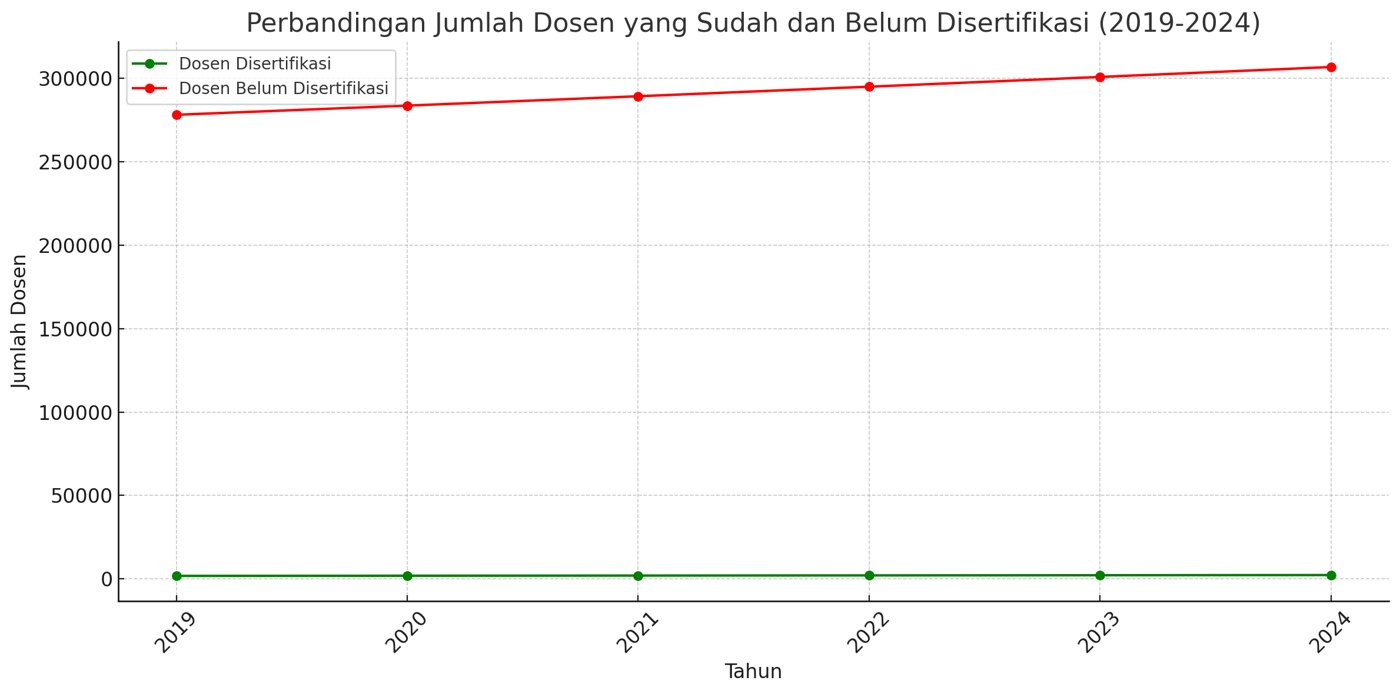
- Certified lecturers in 2019–2024 grew from 1,800 to 2,300 a year, against a total of 280,000–309,141 lecturers.
Recommendations
- Clearer, consistent quality standards and simpler administration.
- Continuous training and professional development for lecturers.
- Equal access to certification for lecturers in remote regions and adequate financial incentives.
- Effective evaluation and monitoring of certified lecturers.
ADI Submits Asta Cita Programme Recommendations for an Advanced Indonesia →
Source: ADI official document “ADI untuk Indonesia Maju”